The basic supply chain activities haven’t changed since 2000. What we always followed is forecast demand > plan materials > buy from suppliers > manage inventory > deliver to customers.
But what has changed is HOW COMPANIES DO THEM.
- In the early 2000s, the focus was → efficiency, cost and inventory reduction.
- In the 2010s, focus started shifting to → better data and collaboration, where connected demand, supply, suppliers and customers came into the picture.
- In the 2020s, everyone started prioritizing → resilience; AI, sustainability and risk management became just as important.
But the important point I would like to highlight is that none of the earlier strategies disappeared. Each decade added to the last. Today’s supply chain combines Lean, digital tools, analytics, resilience and sustainability.
I have seen the supply chain change every decade, as below.
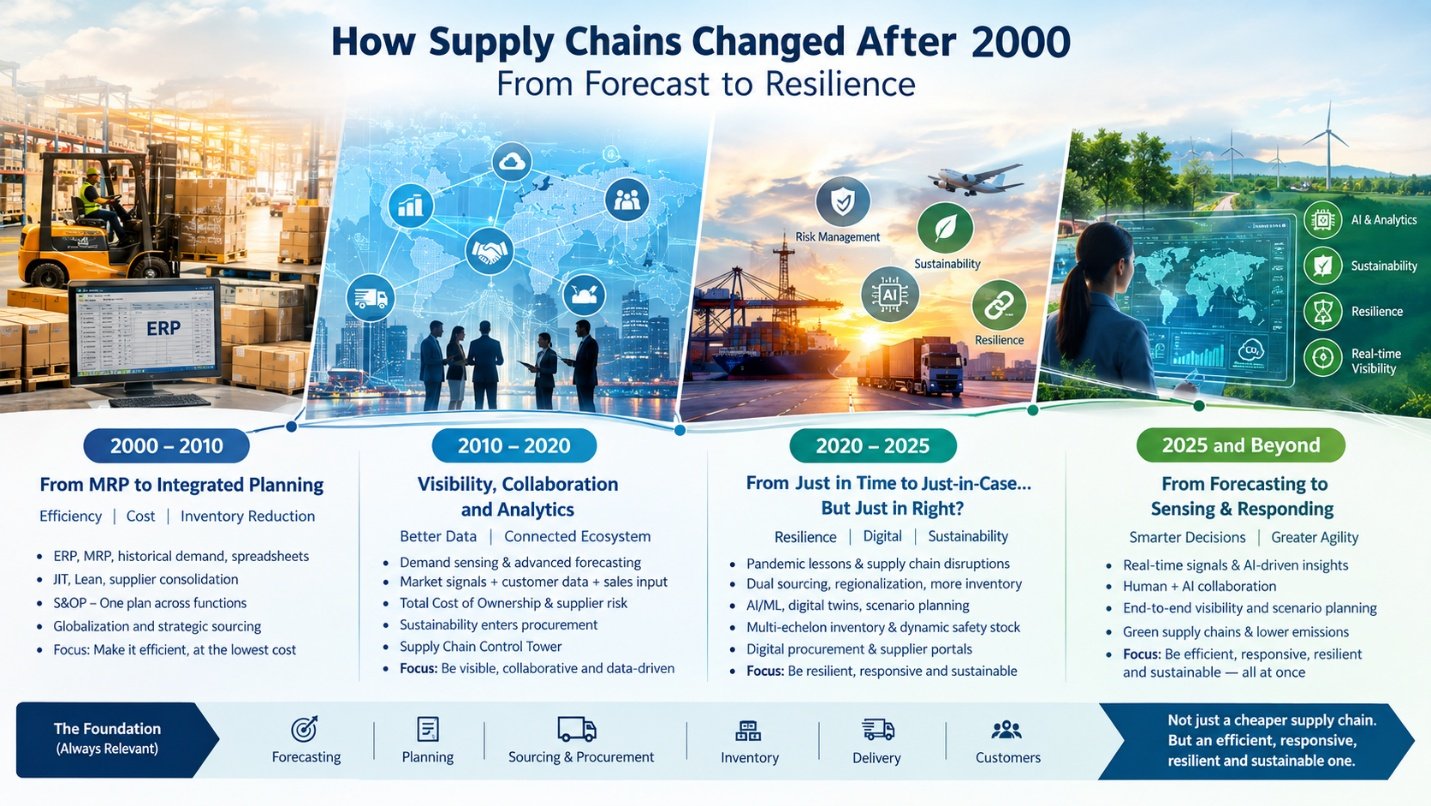
2000–2010: From MRP to Integrated Planning
In this decade, most manufacturers still relied on ERP, MRP, historical demand and spreadsheets. The planning chain was:
Forecast → MPS → MRP → Purchasing → Production → Delivery
The goal was simple → buy the right material, in the right quantity, at the right time and at the lowest cost.
Companies focused on Just in Time (JIT), Lean, supplier consolidation, standardization and inventory reduction. Toyota’s production system was the main reference. Its JIT philosophy was to produce and deliver what is needed, when it is needed, in the quantity needed.
One point is often misunderstood: Lean was never about zero inventory. Inventory could come down only when processes were reliable, suppliers were capable and replenishment was in sync. Toyota treats inventory as part of a wider flow system, not just an accounting number.
Companies also moved from departmental planning to Sales & Operations Planning (S&OP). Here Sales, Operations, Finance and other departments stopped working from separate plans and started working to ONE PLAN.
Key strategies of the decade were good ERP, robust MRP, JIT, Lean, supplier consolidation, S&OP, Vendor Managed Inventory (VMI), EDI, continuous improvement and strategic sourcing.
Toyota’s own logistics shows the shift. In the early 2000s it expanded e-Kanban, cross-docking, global logistics systems and offshore logistics.
The supply chain was becoming more global, but the main question stayed the same:
How can we make the supply chain more efficient by cutting more costs?
2010–2020: Visibility, Collaboration and Analytics
Companies now had enough data. ERP systems were maturing, e-commerce was growing, smartphones were everywhere and cloud technologies boomed.
Forecasts no longer relied only on last year’s sales. Companies used demand sensing on top of statistical forecasting, POS data, customer segmentation, advanced S&OP or IBP, supplier partnership (treating suppliers as business partners rather than just calling them suppliers), predictive analytics and supply chain visibility.
Planning also became collaborative, because the sales forecast was no longer the single input to the supply chain plan. Instead:
Market Signals + Customer Data + Sales Input + Historical Demand + Promotions became the inputs to the planning process
(Consensus Forecast → Supply Plan → Procurement Plan → Delivery Plan)
This mattered because demand was more volatile and product life cycles were shorter.
Fashion is a good example to simplify it. Zara, e-commerce and the FMCG segment started building highly responsive models, where customer demand and trends quickly shaped product decisions and replenishment planning.
In this decade it was no longer just purchasing: companies began looking at total cost of ownership, strategic partnerships, supplier risk and performance, category management, contract management and cost to serve.
I want to say more on one point: sustainability also entered procurement in a more structured way. The problem statement changed from “Can we buy this at the right cost?” to “Can we buy it from a supplier that also meets our quality, ethical and environmental standards?”
One well-known example is Walmart’s Project Gigaton, which began in 2017. It asked suppliers to cut greenhouse-gas emissions in energy, agriculture, packaging, transportation and product design.
So simply, procurement was moving from price and supplier management to value and risk management.
By the end of the decade, the Supply Chain Control Tower emerged. Instead of waiting for a problem to show up in an ERP report, companies wanted live visibility across orders, borders, inventory, suppliers, transport and customers.
This initiative started answering → How can we make the supply chain visible and responsive?
2020–2025: From Just in Time to Just in Case… But Should We Move to “Just in Right”?
In this decade, COVID-19 taught us lessons. We realized that efficiency and resilience are not the same thing, and that a VUCA world holds many more things than we imagined.
We saw many factories close, ports disrupted and transport capacity become hard to find. Demand collapsed for some products and shot up for others.
Importantly, it showed us → companies that had optimized every step for cost and minimum inventory had no room to absorb the shock.
Many research studies from the pandemic showed that companies responded by raising inventories of critical products and components, and by adding dual sourcing (backups) and regionalization. Just in Case inventory came back into the conversation.
But the real lesson is not “JIT is bad and Just in Case is good” → that will always be a good debate.
What I realize here is that inventory should be designed around risk, not simply minimized.
In a nutshell, for a low-value, short-lead-time item with multiple suppliers → very low inventory makes sense. But for a critical component with a longer lead time and a single source, extra inventory is insurance.
Ultimately, inventory is waste when it exists because of poor process design. It is protection when it covers real uncertainty. The goal is not minimum inventory, but the right inventory.
In this decade, digital planning also accelerated. For instance, Amazon uses ML models to forecast demand for 400 million+ products a day and decide what inventory to place at each facility. Instead of asking “What did we sell last year?”, the system reads many demand signals and keeps updating the forecast.
Thus, the last five years brought → AI/ML, demand sensing, digital twins, control towers, scenario planning, risk analytics, multi-echelon inventory planning, dynamic safety stock, dual sourcing and supply chain resilience.
Procurement went digital as well, with automated purchasing, supplier portals, smart contracts, spend analytics and AI-assisted insight for supplier evaluation.
Something That Has Emerged Strongly: Sustainability
Since 2010, or more precisely since the 2020s → CO2 emissions have become a supply chain issue, not just an environmental one.
Forecasting affects emissions in both directions:
Overforecast → Excess Production → Excess Inventory → Extra CO2
Underforecast → Emergency Production → Premium Freight/Transport → Higher CO2
Better forecasting can cut both financial waste and environmental impact.
Procurement matters even more, because much of a company’s footprint sits upstream with suppliers. Companies like Unilever work with their suppliers on product-level greenhouse gas data and reduction plans for raw materials, ingredients and packaging, which make up a large share of value chain emissions.
Again, Walmart’s Project Gigaton aimed to reduce or avoid 1 billion+ metric tons of greenhouse gases by 2030. The initiative ran so strongly that Walmart announced supplier-reported projects were expected to beat that target much earlier than planned.
2025 and Beyond: From Forecasting to Sensing & Responding
The old model was:
Forecast → Plan → Execute
The emerging model is:
Sense → Predict → Simulate → Decide → Execute → Learn
AI can process sales history, promotions, customer behavior, market information, weather, economic indicators and other external signals to show possible demand scenarios. I would not treat AI as a superpower here: the maturity of supply chain planners and cross-functional collaboration matters more, and always will.
AI and human judgment have to work together. AI may flag a supplier as risky, but a procurement leader still has to understand the relationship, negotiate alternatives and decide how much risk to accept. AI may generate a forecast, but a demand planner may know a major customer is launching a new product next quarter, which isn’t in the historical data yet.
Conclusion
Every decade brings change, but supply chain strategy has not swapped one philosophy for another. It has accumulated over time.
We still need Lean, accurate forecasting, robust ERP and MRP, good suppliers and inventory discipline. But we now also need to handle disruption, carbon, geopolitical risk, digital signals and shifting customer behavior.
The future may not be Just in Time or Just in Case. It may add “Just in Right”:
- Right inventory for the risk.
- Right supplier to streamline disruptions.
- Right forecast for the decision.
- Right transport mode for the urgency.
- Right level of automation for the process.
- And increasingly, the right carbon footprint for the planet.
The goal is no longer just a cheaper supply chain. It is efficient, responsive, resilient and sustainable all at once.
Questions to Ask Yourself
- Looking at your current supply chain strategy, which decade’s mindset is driving most of your decisions today? Are you behind or ahead of the game?
- Is your supply chain building resilience while actively cutting carbon, or are you still sacrificing one for the other?
- Which decade brought the biggest turning point for your supply chain team: the 2000s, 2010s, or 2020s?